Pages

Showing posts with label game design. Show all posts

Thursday, June 21, 2012

Hollow World: Torn Asunder


The Sundering

Our beautiful world was torn in half.

Once, the world was calm, peaceful, fully known. We had no questions about the world we lived in--certainly, philosophers waxed eloquent about the possibilities of afterlife, the old superstitious concepts of an Outworld, full of daemons, but it was more an academic exercise. In the last two years, though, we have realised how wrong we were to ignore those wise ones.

Though a small world it was, its smallness gave us safety, security, and peace. These last two years have ravaged our world: the climate now varies two or three times a year, there are regions of the world that are always cold, farms no longer produce crops year round... Worst of all, though, are the phantasmagorical phenomenae. The gulf of void that separates the Lower World and the Upper World is, we fear, a gateway from the Outworld.

Strange things happen daily. People disappear, bodies are found sacrificed on strange altars, animals scatter when nothing is present, birds take flight in strange new patterns, and some even claim they see blood in the sky. These are read as omens by most people; they consider them signs of pending doom from Outworld. Meanwhile, others claim that the sundering of the world is a time of excitement, of opportunity for exploration, redemption, salvation.


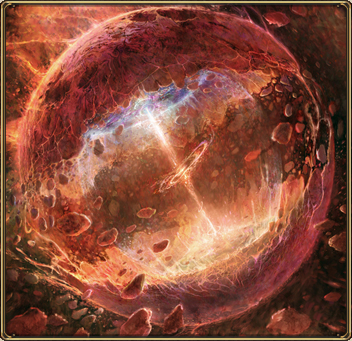
Art shamelessly borrowed from a Google Image search. I think maybe it's from the MMO, Aion.


Thursday, June 14, 2012

How Big is Your Sandbox? aka Player Decision Leeway

I started a discussion last night on G+, where I simply asked the question "how big is your sandbox?" I also clarified that I wasn't referring to geography.
Some great responses were posted, but no one really mined the vein I was thinking, because I wasn't very specific.

How much leeway or freedom do your players have in the sandbox?

I have recently decided to think of sandboxes as varying in size. Here is a rough breakdown:

  • Infinite breadth of options
    • In this type of sandbox, players are given a literal "anything goes" card. The DM either has invested a ton of time in preparation, or is (like me) relying on his ability to build on the fly.
    • Players are not given any scenario or issue to consider. They are merely placed in a world, given descriptions of that world, and asked "What do you do?"
    • There is no starting point or ending point for adventures in this type of world.
  • Limited breadth of options
    • While the DM may have a world planned (or created on the fly) that can accommodate the "infinite options" type of game, for some reason he or she has chosen to limit the PCs in some way.
    • Examples of this include my recent Savage SciFi game-- I created a world, gave the PCs vast input in its creation, but set up a specific starting scenario. No goals were laid out by me, but there were a few more obvious possible outcomes of the initial scenario. Because I gave the players full freedom at every turn, though, they surprised me at every game session.
    • There is a definite starting point for adventures in this world, which naturally precludes some options, but can help set up a particular style of adventure. No end point is laid out.
  • Railroad with options
    • I think of this as analogous to most RPG video games, like Final Fantasy. While there is freedom to explore the world, level up, pursue side quests, the DM still has a definite "win scenario" in mind (or maybe two or three scenarios.)
    • I hesitate to use the term railroad for this type because it is still not a set in stone type of plot. It is probably much more flexible than the stereotypical railroad.
    • You can think of this type of sandbox as having a line laid in it, showing a start AND end point.
  • Railroad (aka Not a Sandbox)
    • Do I really need to define this one?

Wednesday, June 13, 2012

"Post-Dungeon" People

The other night, while discussing the upcoming game for Monday nights, I had a spark of thought, and wanted to share it. Credit for the spark goes to +Kyrinn S. Eis, though I cannot say if the thoughts I present below are in line with hers.

The term Kyrinn used was "a post-dungeon person." I like this term, it has a nice ring to it, and gets to the point: a post-dungeon person is someone who does not play RPGs thinking that a dungeon crawl is the only type of game out there, or (more likely) they avoid dungeon crawls altogether.

My disclaimer here is that, I think, everyone enjoys a crawl every now and then. I probably don't crawl as often as some of the old grognards, but I do love a good dungeon crawl. Emphasis on "good." The other thing about me is that I enjoy more types of games than a dungeon crawl.

So what's my point? Well, I think a key distinction between gamers should be less about "old school" and "new school" styles, and more about what game we are playing.
I often hear haters, on all sides of every fence, complaining that "such and such just isn't D&D" or "<xyz> ruins <abc> about the game." What if, instead, we recognized that we are playing different games with the same name? D&D, and all RPGs, really, are usually more versatile than we give them credit for being. Yes, the original D&D games were written for dungeon crawls and wilderness hex crawls. That means that "dungeon crawl" and "hexploration" are the games you are playing--not D&D! (Rather, it's more important to identify what game you are playing outside of the name of the rule set.)

This is a big part of why I try to name every campaign or game I run, even if that is a name just for me. It allows me to separate MY game from the rules set I"m using to facilitate the game. So, if you choose to only play a "traditional" or "old school" game, that's great. Use D&D, use a retroclone, use True20--whatever you want. But keep in mind that no matter what rules you use, someone else is using those same books to accomplish a different goal; they are trying to play a different game.


My point here is not to cause dissent or to upset and offend. These are thoughts I have, and you are free to respond to help me reshape them, and I am free to keep/discard/change them during the discussion.

Saturday, May 26, 2012

Savage SciFi: Sit-rep

We've played a few sessions of the Savage SciFi game, and I've been out of town for a couple weeks, but things are looking good now...

I have been more than pleased with everyone's ability to dive in to world creation. My goal at first was to create a small scenario and let the players work their way through it, and then call it quits. The problem with that? They ate it up. Every bit of lore I was creating (on the fly, by the way, *gulp*) the players devoured and asked for more.
Within the first session they were taking the lore I had given them and using it to try and figure out what was going on "behind the curtain." I love this kind of game!

The key, I think, has been to minimize pressure on myself as a GM. I'm relying on what I think is my best skill: improvisation. It was a bit rough at first, but by the second session I had a list of random-ish names, locations, ships, etc (no stats, of course) that I could draw on at a moment's notice if needed.

My players have been integral in the whole process, too. At the character creation session I asked them, based on the one-page world background I wrote, what they wanted to do and where they wanted to fit into the world. Each player contributed something monumental and integral to the world and its history, whether they realized it or not. This allowed me to build their characters into the scenario nicely.

Now, they have navigated their way beyond my initial idea, and I'm trying to do some by-post roleplay on G+ to see how they fill their in game down time and to see what leads and hooks they will chase down.
I'm not sure how many more sessions we will play, but I'm eager to keep these players around, and they may (if willing) turn into "my" group for the next game or games.

And yes, to my players, I have a nice way to wrap up the whole thing. I think you'll love and hate it. Mwa ha ha ha ha. Etc.

Saturday, April 7, 2012

Limited Series: Savage SciFi

It's dark as you open your eyes, straining to make out the motion and faint lights that woke you. Heavy isn't the right word for how your head feels--stagnant, like water that hasn't moved in years, yes, that's it.
Light attacks your eyes, harsh, and abrasive. Someone is walking into the room, beyond the plasteel covering your cryo-pod. It is a cryo-pod, isn't it? The last thing you remember is the technician attaching a tube to the shunt in your arm, telling you to count back from one hundred. Yes, this must be a cryo-pod--you can see your breath now as your lungs warm up.

The movement is a man. Or maybe a woman. But not like any you've seen before: deep cerulean skin, black as tar hair, lizard-like movements. You think it's a male, assuming its species has a biology anything like your own, and watch him through barely open eyes, hoping he won't notice you're awake.
Where are the technicians? Why haven't you woken up for your maintenance rotation on the ship? You were supposed to be woken up by the ship every five years to check the ship. Everyone gets woken up, in shifts, to make sure the ship is sailing smoothly.
There are no humans in the room, but now there are two of the blue people, and one of similar build and biology but with a deep, emerald coloured skin. This one seems to be giving orders, barking something in a language full of clicks, pops, and buzzes. All the while, the green one is staring at you and the other pods in the room.

Only five pods in this room. You can see all of them, and you know that's standard thawing procedure--five at a time, in a room just off the main cryo-hall on the ship. There are two thaw rooms, actually, so it's a total of ten at a time. Not that it matters: these probably aren't friendlies thawing you out.

You have spent the last three years preparing for this expedition. The team was put together by Phoenix Corporation, a company contracted by the United Earth Defense Organisation--UEDO. Phoenix is a privately held company, but then all groups capable of interstellar flight are, as governments have other things to spend money on. Like contracts with those companies. This arrangement allows the innovations of the private sector to benefit the federal governments of earth directly, and leaves the private firms open to private customers, too.
The expedition launched, the ship left the station orbiting Earth, and made only a stop at Mars for a send-off from the colonists. After that, it was down for cryo-sleep, with the last sleeper having to plug herself in and let the computers pump in the drugs.

How long has it been? Where are we?

Friday, March 23, 2012

HoS: What Needs to Improve

Yesterday I outlined a couple of elements of Houses of Stone which, I think, made it particularly enjoyable. Today, I want to talk about a few things I need to do better when the game launches again in a few weeks...


  • Planning:
    • Normally, I shoot from the hip. This works impeccably well with NPC interactions, events, reactions of the world, etc. Shooting from the hip works best, though, within pre-established geographical and architectural locations. By this I mean that I need the city, buildings, caves, underground cities, etc all laid out and stocked. The NPCs should have one-liner personality, motive, and objective descriptions. This will make shooting from the hip more effective and allow me the comfort of knowing what's in the sandbox before the PCs get there.
  • Turning it up to 11:
    • Houses of Stone, as it existed for five game sessions, was barely a level 1 world, in terms of challenge and lethality. Being more proactive in planning and design will allow me to add to the challenge, difficulty, and potential lethality that players will see as they play. This will also help me establish baselines for what PC capabilities players will be disallowed, allowed, etc.
  • Puzzling:
    • The unanimous response I got in every bit of feedback about the game was that people loved the puzzles, the questions, the mysteries. A lot of these were off the cuff ideas I had or moments where I said to myself "I know there should be a trap, puzzle, or mystery here but I didn't plan it out... let's see what the PCs try and assign odds to how likely each solution is." I call this "quantum mechanics of DMing" or as one player put it "Schrodinger's puzzle."
    • I don't want to remove this method of DMing and design. It works very well and is a lot of fun. However, I do want to temper it with real design. If the sandbox contains all sorts of things for players to discover, it needs to have some things that will confound them, as well as things that adapt to their attempts.

Thursday, March 22, 2012

HoS: What Made it Fun?

Let's talk about what has gone really well in my five-session Houses of Stone game.
Quick recap of essential info if you didn't play:
- Swords & Wizardry Core rules (mostly)
- Sub-Saharan Africa in an alternate timeline
- History coming out the ears of every NPC, location, and item

I have run five sessions of this game so far, and enjoyed every one, and I believe the players did, as well. The first and foremost thing I think we all enjoyed was history.
The history in this world--the things the PCs had no knowledge of but uncovered by role-playing interactions with NPCs, by exploring locations, by investigating events, by inquiring about items and events--was pretty well laid out, if I do say so myself.
We only really "delved" into dungeons/caves in two of the sessions. Even then, though, only one was a real delve, where the PCs spent almost the entire session exploring the turns and twists of the underground complex. The very first session had about 45% of the time spent in the dungeon, but with a considerable amount of investigation and interaction happening before and after, arguably being the more enjoyable part of the game.
So, my point is, I think the players enjoyed learning by exploring, inquiring, and investigating what the history of the world was.

Second, I think everyone enjoyed puzzling items and contraptions. The simplest things, like a panel of buttons on a purely granite wall in an iron age world, activated by the Fibonacci sequence, was incredibly fun to see players work through.
The puzzles and contraptions, too, contribute to the history-delving of the world. Even though these are classic dungeon puzzles/traps/contraptions/conventions, they played right into the mystery of the ancient race who built the city.

Monday, February 6, 2012

I'm in a 3e State of Mind

Yes, I'm using Billy Joel lyrics. You wanna fight about it?

I have, several times, recently found myself in a particular mindset or frame of mind about things related to gaming, putting together games, and so on. In fact, I've eaten my own words recently in a G+ discussion about FLAILSNAILS because I interpreted it from what I call a "3rd edition point of view" rather than reading it without preconceptions.

Let me 'splain... I began my delve into the realms of D&D and other pen and paper games in the year 2000--I never picked up an AD&D 2e book, as my library had several shiny new copies of the 3rd Edition Player's Handbook. In fact, nearly twelve years later, I've never even played AD&D 1e or 2e, though I've played in games that borrowed some of their concepts.

I have a friend, whom I game with quite often in person, who started playing in the days of 2e, but has spent most of his time, like me, playing and GMing 3e, 3.5e, and Pathfinder. I don't think this is bad at all--in fact, both of us agree that rules systems matter very little at the table, as long as you have a core mechanic to fall back on and agree that the GM has the final say over rules decisions and tries to keep it as simple as possible.

Now, flash forward to today. I was fascinated when I first heard of the "FLAILSNAILS" concept, but since I haven't had much free time on my hands, hadn't dug into very deeply. (I've played a handful of OD&D / Swords & Wizardry games and loved them, and it's at the top of my gaming priority list to get in on a G+ Hangout game using some form of those rules.)

FLAILSNAILS is, apparently, a super simple concept: GMs advertise their games as FLAILSNAILS friendly and as long as the character being imported is compatible (in the GM's view) it can be used. Easy, right?

Not according to my frame of reference, apparently. I read it as "FLAILSNAILS is a set of guidelines by which you can create a character that can then be imported into a game and then on to another later, as long as the GM running each game is using the compatible rules system." This misinterpretation of a simple way to allow players to play more often stems from a tradition in the 3e (and even 4e) era of D&D gaming that says "Here's the master list of all splatbooks I will allow automatically. Anything not on here must be approved by me."

Oddly enough, that's not how I like to run games. I usually say "Whatever's in the core book(s) is fine; anything beyond that...  just show me your concept and we'll find something mechanically that fits." This is readily evident in the Savage Worlds game I'm getting ready to launch in a custom setting. There's no prewritten "splatbook" or "campaign setting guide" that I wanted to use so I told my players to write character concepts based on their understanding of the world and anything not covered in the core Savage Worlds book would be house-ruled in as simple a way as possible.

I love the simplicity of this type of game creation. So why oh why is it so hard for me to let go of 10+ years of the splatbook-heavy mindset?